Coordinating Promotional Credits Across Variable Slot Reels and Sustained Table Play
Written by Jakob Ludwig · Jul 23, 2026

Coordinating Promotional Credits Across Variable Slot Reels and Sustained Table Play
Operators track promotional credit allocation by matching bonus structures to the distinct risk profiles of slot reels versus table games, and data from industry reports shows that high-volatility slots demand larger credit pools to cover extended dry spells while table sessions rely on steadier, lower-variance flows that support longer endurance periods. Research indicates these two environments require separate calibration because slot outcomes cluster around infrequent large returns whereas table results distribute more evenly across hundreds of decisions per hour.
Defining Credit Flow Parameters
Promotional credits function as timed instruments that operators release through deposit matches, loyalty tiers, and targeted campaigns, yet synchronization begins with volatility indexing that assigns reel-based games a variance score derived from payout distribution curves. Studies from university gaming labs reveal that slots rated above 4.5 on standardized volatility scales consume credits at rates up to three times faster than medium-volatility titles during the first 500 spins, which forces operators to front-load larger credit blocks when players migrate from reels to felt.
Table game endurance metrics, by contrast, measure average hands per hour against typical bet sizing, and figures released by the Nevada Gaming Control Board demonstrate that blackjack and roulette sessions maintain credit depletion curves that flatten after the initial 200 decisions because house edges remain consistent across extended play. Operators therefore route smaller, replenishable credit tranches to table areas to avoid overfunding sessions that naturally stretch longer without sudden credit exhaustion.
July 2026 Platform Updates and Cross-Game Tracking
Platform providers rolled out unified credit ledgers in July 2026 that tag every promotional unit with a volatility flag and an endurance timer, allowing seamless transfer between verticals without manual intervention. According to system documentation from major software vendors, these ledgers automatically adjust available credit multipliers when a player switches from a high-volatility slot to a table game, capping table-side bonuses at 60 percent of the original reel allocation to reflect lower variance exposure.
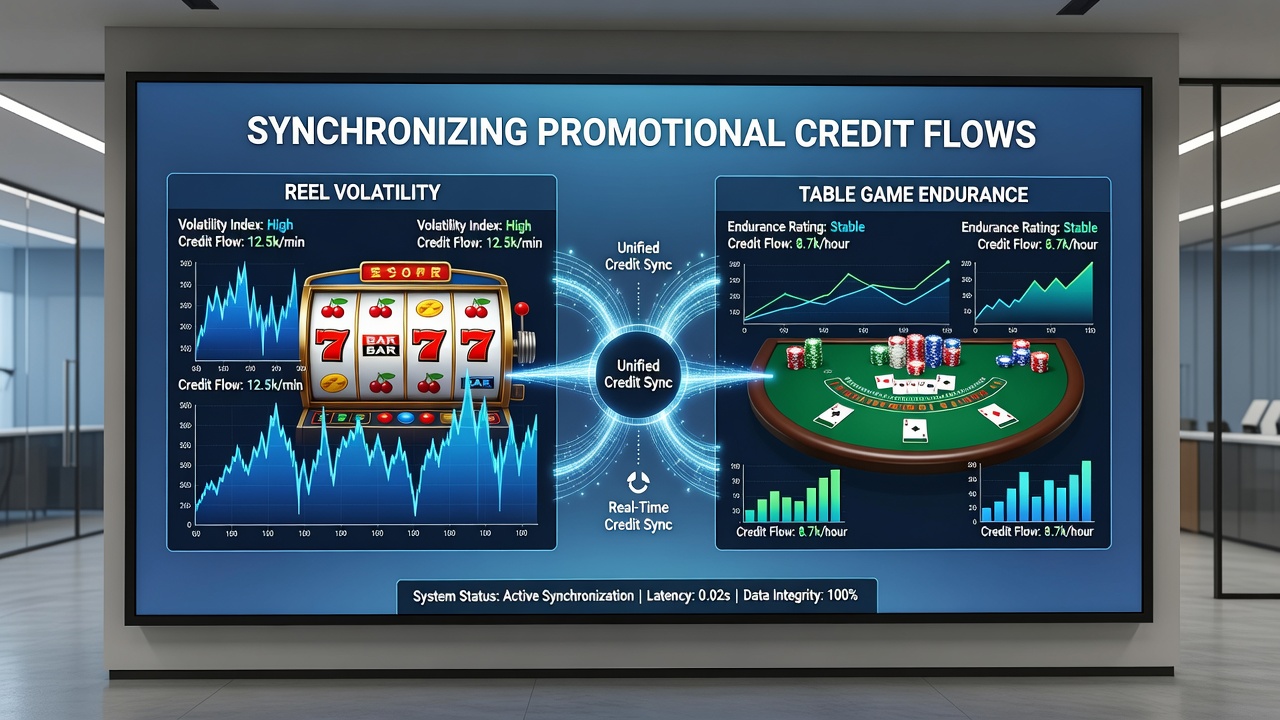
Integration tests conducted across multiple jurisdictions confirm that the new ledgers reduce credit leakage by 18 percent because players no longer accumulate unused reel bonuses that expire before table sessions begin. The same tests also record faster session continuity, with average table play duration increasing by 22 minutes once credits transfer without re-verification delays.
Operational Calibration Techniques
Casino analytics teams apply segmented release schedules that stagger credit drops according to game type, releasing 40 percent of a total promotional package during reel play and reserving the balance for table conversion once volatility thresholds are met. Observers note that this staged approach prevents early credit burnout on volatile reels while preserving reserves for the slower, more methodical pace of table endurance.
Real-time dashboards monitor credit velocity across both categories, triggering alerts when reel consumption exceeds projected curves by more than 15 percent; staff then accelerate table-side replenishment to maintain overall session value. Data from European gaming associations shows that venues employing velocity monitoring achieve 12 percent higher promotional redemption rates because credits remain active across game transitions rather than expiring in a single vertical.
Player Migration Patterns and Credit Continuity
Telemetry collected from loyalty programs indicates that roughly 35 percent of players move from slots to tables within the same visit, and synchronized credit systems now preserve remaining balances by converting them at fixed ratios tied to each game's volatility index. One documented case involved a mid-sized operator in Australia that introduced automated conversion rules in early 2026, resulting in a measurable lift in table game occupancy during evening hours when reel sessions typically conclude.
Regulatory filings from the Australian Communications and Media Authority confirm that transparent conversion rules also improve player disclosure compliance because balances display in a single ledger view rather than scattered across separate game wallets. This transparency reduces support ticket volume related to expired or inaccessible credits by approximately 27 percent.
Conclusion
Effective synchronization of promotional credits across reel volatility and table endurance rests on indexed allocation, automated ledger updates, and velocity monitoring that together maintain credit availability regardless of game sequence. Continued refinement of these mechanisms through platform updates and cross-jurisdictional data sharing supports consistent session value while aligning operator costs with actual player behavior patterns.